BROOKLYN DAILY EAGLE AND EAGLE WAREHOUSE
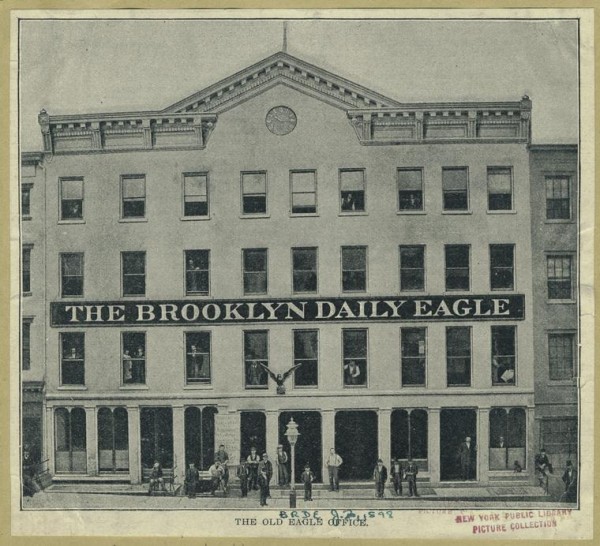
Shortly after the Brooklyn Daily Eagle started publication on October 26, 1841, it moved to 30 Fulton Street between Elizabeth and Hicks Streets, a lot that was previously occupied by a Dutch farmhouse before becoming the newspaper’s home for the next fifty years. The Eagle’s original two-story building housed a business office and press room on the first floor and an editorial and composing room above it where Walt Whitman worked from 1846-1848. It’s location on the lower end of Fulton Street, which had become the economic and social artery of Brooklyn thanks to its proximity to the Fulton Ferry landing and the bustling shipping business along the waterfront, perfectly situated the paper to gather and distribute news to the city’s growing population of over 35,000 people.
As its circulation expanded and demand increased, the Eagle purchased a new two-cylinder steam powered press from R. Hoe & Co. in 1853 and then a four-cylinder press in 1858 which was capable of printing 10,000 copies an hour. Although the new cylinder presses had a substantially higher output than the handpress that preceded them, they were also much larger and required engines and boilers for power. In order to accommodate the machinery and the staff required to operate them, the Eagle purchased 34 Fulton Street in 1860 and expanded its footprint east to Doughty Street. By 1872, the Eagle had upgraded to two R. Hoe & Co eight-cylinder presses, each capable of printing 40,000 copies an hour, and had annexed 36 Fulton street as well. Ten years later, in 1882, the Eagle purchased additional property to the west, formerly the American Hotel, and had G.S. Morse design a three story, fireproof, brick building to house its operations. The original building and additions were completely razed to make way for the new building’s engine rooms and the massive foundations required for the two newly acquired perfecting presses which each printed 24,000 double-sided copies an hour. The Brooklyn Daily Eagle would only remain at their new Fulton St. offices for 10 years before relocating to a brand new lavish 9-story building on Washington and Johnson streets in 1890.
In 1894, Brooklyn Eagle Warehouse Co. purchased the property on Fulton Street and demolished the former offices of the Brooklyn Daily Eagle, leaving only the press and composing rooms on the corner of Elizabeth and Doughty street standing. The new six-floor romanesque revival building was designed by Canadian born architect Frank Freeman and served as fire and theft proof storage for furniture, paintings, and silverware. The building was designated a landmark structure in 1977 by the New York’s Landmarks Preservation Commission and was subsequently purchased in 1978 for 3 million dollars by Benjamin Fishbein and converted into eighty-five residential units.
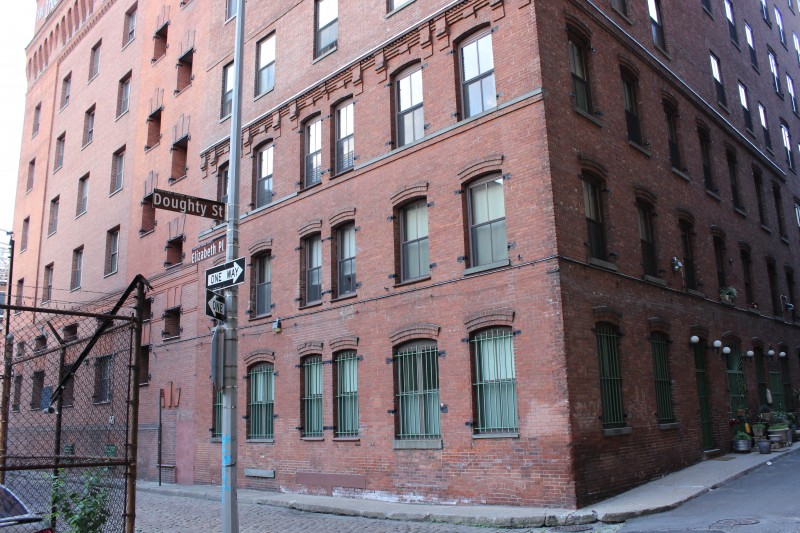
Eagle Warehouse, view of the remaining section of the 1882 Brooklyn Daily Eagle Offices.