PLYMOUTH CHURCH
Often referred to as the “Grand Central Depot” of the Underground Railroad due to its role in the Abolitionist Movement, Plymouth Church was Brooklyn’s Second Congregational Church and a vital part of the vibrant religious community of Brooklyn Heights in the 19th century. Founded in 1847, the church’s first pastor Henry Ward Beecher, brother of Harriet Beecher Stowe (Uncle Tom’s Cabin), was an outspoken opponent of slavery and frequently delivered passionate abolition sermons. After a fire destroyed the original church in 1849, Beecher led the construction of a new meeting hall which opened in 1850 at 57 Orange street. The building, which still stands today, features a 2,800 person capacity, a theatre layout, exceptional acoustics, and was designed by the architect J.C. Wells with input from Beecher who envisioned a space that would allow him to be surrounded by his congregation. Beecher used this setting to foster an intimate relationship with his audience, a connection he used to great effect particularly when he addressed the issue of slavery. The most famous of his dramatic sermons involved a mock-auction of a 9-year-old slave girl named “Pinky” in 1860. Acting as an auctioneer, Beecher inspired his congregation to donate over $1000 to purchase the little girl’s freedom and pay for her education. At the conclusion of the emotional event, Beecher found a small gold ring in the collection dish which he presented to the girl as her “freedom ring.”
Whitman fondly recalled meeting Beecher several times during his life. He commented that Beecher was a “great absorber” of Leaves of Grass and that “perhaps quite unconsciously he imbibed, accepted, its spirit: molded many of its formulas into his own” (WWWIC 3 456-457). He was also impressed with the preacher’s oration skills, particularly his ability to speak directly to his audience with a sense of passion and spontaneity. In one conversation between the two on the subject, Beecher stressed the importance of “contact” with the audience and the ability, “to trust to the communications of the moment—to feel the throb—joy, sadness, expectancy—of the people gathered together” (WWWIC 8 400).
Aside from Beecher, Plymouth Church also hosted a number of other abolitionist speakers including William Lloyd Garrison, Sojourner Truth, Wendell Phillips, Charles Sumner, and Frederick Douglass. Abraham Lincoln also attended services twice at the church in 1860; a silver plaque still marks the pew where he sat. Whitman, who was close with many of the abolitionists in New York, regularly attended gatherings at anti-slavery halls and was likely aware of the these events at Plymouth Church. He openly considered himself anti-slavery and was believed to have lost his editorship at the Brooklyn Daily Eagle due to his vocal support of the Wilmot Proviso which sought to ban slavery in newly acquired territories following the Mexican War. Despite his public stance, however, Whitman took a much more nuanced approach to this sensitive topic in his poetry, particularly in Leaves of Grass. To him both the slave and slave owner were inseparable and necessary components of his book’s holistic scheme and perhaps he felt that the inclusion of anti-slavery sentiment would ultimately have upset the balance he attempted to strike in his work: “I am a great contender for the world as it is—the ill along with the good. Indeed, I am more and more persuaded that the ill, too, has its part to subserve—its important part—that if it did not exist, it would be a hopeless world and we would all go to the bad” (WWWIC 5 276).
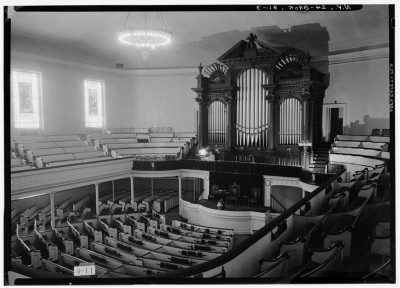
E.P. MacFarland. “Plymouth Church, Orange & Hicks Streets, Brooklyn, Kings County. ” Historic American Buildings Survey, NY., Library of Congress Prints and Photographs Division, 26 April 1934.
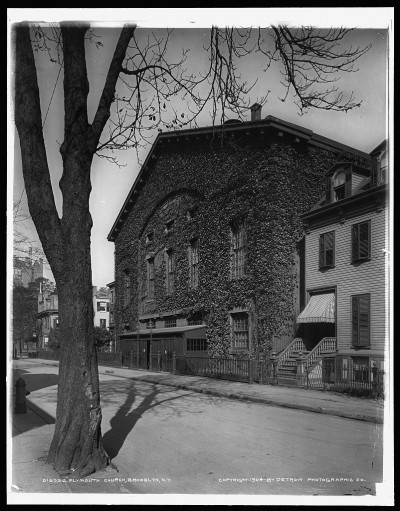
E.P. MacFarland. “Plymouth Church, Orange & Hicks Streets, Brooklyn, Kings County. ” Historic American Buildings Survey, NY., Library of Congress Prints and Photographs Division, 26 April 1934.
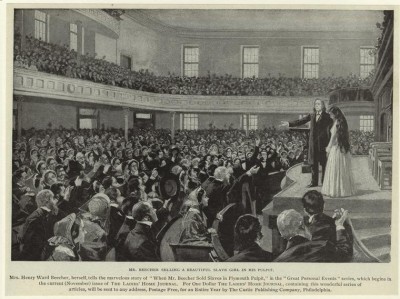
Art and Picture Collection, The New York Public Library. “Mr. Beecher Selling A Beautiful Slave Girl In His Pulpit.” The New York Public Library Digital Collections.