THE FIRST EDITION OF LEAVES OF GRASS
“The first Leaves of Grass was printed in 1855 in Brooklyn New York—small quarto 9 by 12 inches, 95 pages—in the type called “English”—was not stereotyped—800 copies were struck off on a hand press by Andrew Rome, in whose job office the work was all done—the author himself setting some of the type” (Whitman).
The first edition of Leaves of Grass emerged during a time of rapid technological and social change during the mid-19th century and was itself a radical transformation of American literature and poetic conventions. From the intimate, sensual, poetic persona at its heart, “Walt Whitman, an American, one of the roughs, a kosmos,” to the sprawling lines of rhymeless freeverse and lengthy catalogues, this compact book of twelve poems and a prose preface was a groundbreaking original work. It was Whitman’s all-encompassing democratic manifesto which announced his arrival to the world and also laid the foundation for the masterwork he would continually expand, revise, and reorder throughout his lifetime.
Self-published in Brooklyn during the spring and summer of 1855, Leaves of Grass was printed on a handset press at Andrew Rome’s small shop on the corner of Cranberry and Fulton streets where Whitman was able to oversee nearly all aspects of the book’s creation from the binding and layout to the typesetting and font selection. While Whitman even claimed to have set the type for several pages of the book himself, on most days Andrew and his brother Thomas would run the handset press while Whitman proofed the copies as they came off the press. It was a low-cost, hands-on approach that had roots in Whitman’s experience as a printing apprentice and newspaperman and one that resulted in a multitude of first edition textual variations including corrections and changes to poems made during the print-run.
Once the printing was completed, and Whitman could afford the cost of binding, the signatures were sent to Jenkins Bindery or Davies & Hands in Brooklyn for assembly. Whitman, attempting to appeal to multiple audiences, offered three main bound versions, or “states,” of his book to the public: the first state, the most luxurious and ornate, featured a green morocco cover with gilded lettering and decoration that cost $2; The second state replaced the leather binding with cloth and cost $1; the third state was covered in pink or light green paper and cost only 75 cents. In total, between June 1855 and January 1856, 795 copies of Leaves of Grass were produced: 337 first-state bindings; 262 second-state; 46 bound cardboard; and 150 in paper (Folsom 81).
On July 4, 1855, Leaves of Grass went on sale, but received very little critical or public attention aside from the glowing reviews which Whitman wrote and published himself. As he reflected later in his life, “It is tragic—the fate of those books. None of them were sold—practically none—perhaps one or two, perhaps not even that many. We had only one object—to get rid of the books—to get them out someway even if they had to be given away. (WWWIC1 92). Despite the overall poor reception, Whitman did receive a personal letter from the well-known essayist Ralph Waldo Emerson who praised the first edition as, “the most extraordinary piece of wit and wisdom America has yet contributed,” and greeted the poet “at the beginning of a great career.” The letter not only buoyed Whitman as he continued production of the second edition of Leaves of Grass, it also proved to be a strikingly accurate prediction of the unknown writer’s work and future. Ultimately, Whitman would go on to publish six distinct editions of Leaves of Grass during his lifetime, the final version containing an impressive 293 poems composed throughout his prolific career. It remains one of the most influential works of American literature and continues to inspire countless artists and scholars today.
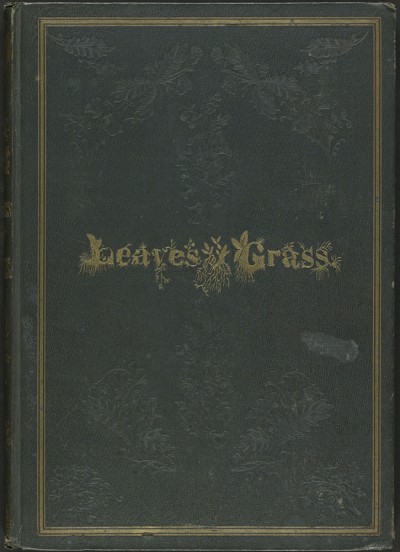
Whitman, Walt. “Cover.” Leaves of Grass. Brooklyn, New York: 1855, University of Iowa Libraries, Special Collections & University Archives, Walt Whitman Archive.
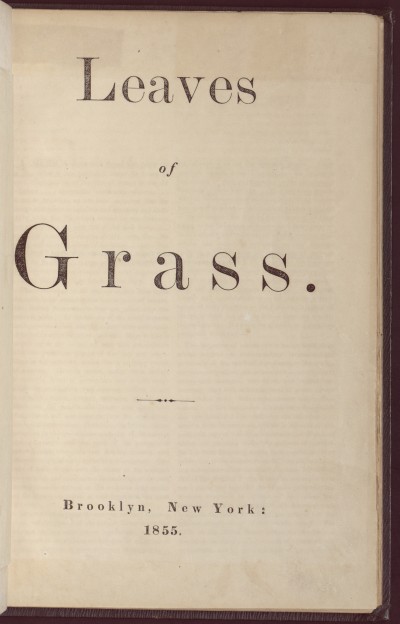
Whitman, Walt. “Title Page.” Leaves of Grass. Brooklyn, New York: 1855, University of Iowa Libraries, Special Collections & University Archives, Walt Whitman Archive.
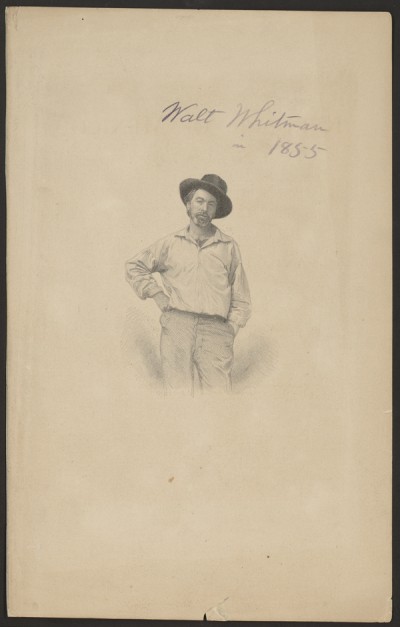
Walt Whitman, three-quarter length portrait, facing front, as a young man, dressed in rural attire for frontispiece of Leaves of Grass. Feinberg-Whitman Collection, Library of Congress, 1854.