ROME PRINT SHOP
The Rome Brothers print shop was located in a three-story red brick building that once stood on the southwest corner of 98 Cranberry and Fulton Streets (now Cadman Plaza West). Owned and operated by Scottish immigrants Andrew and James Rome, the shop primarily printed legal documents, city and county reports, and sermons until 1855 when Andrew and his younger brother Tom worked with Whitman to publish the first edition of Leaves of Grass. Following their work on the first edition, the brothers maintained a productive working relationship with Whitman for many years, setting type for his new poems and printing proofs in 1858 and 1859 for future editions of Leaves of Grass. Although the first edition manuscript was allegedly destroyed (Whitman recalled it had been kept at the print shop for several years before being accidentally burned), the Rome family did preserve several of Whitman’s original manuscripts which continue to provide unique insights into Whitman’s creative process and development.
Long after the Rome Brothers discontinued use of 98 Cranberry, the building continued to be connected to Whitman. On May 31, 1931, at a celebration of Whitman’s 102nd birthday, a bronze tablet, created by sculptor Alexander Finta, was dedicated and mounted on the side of the building to mark the site’s historic importance. It contained interpretations of four of Whitman’s poems: “Oh Captain, My Captain!”, “Old Ireland,” “Passage to India,” and “Great are the Myths.” Unfortunately, despite efforts by the Committee to Save the Walt Whitman Building, which included many local residents and notable writers Carl Sandburg, Robert Frost, Marianne Moore, Archibald MacLeish, Arthur Miller, and Malcolm Cowley, the property was eventually demolished in 1964 as part of the Cadman Plaza redevelopment plan. The plaque was said to have been removed from the building before it was razed, however, attempts to locate and recover it have been unsuccessful.
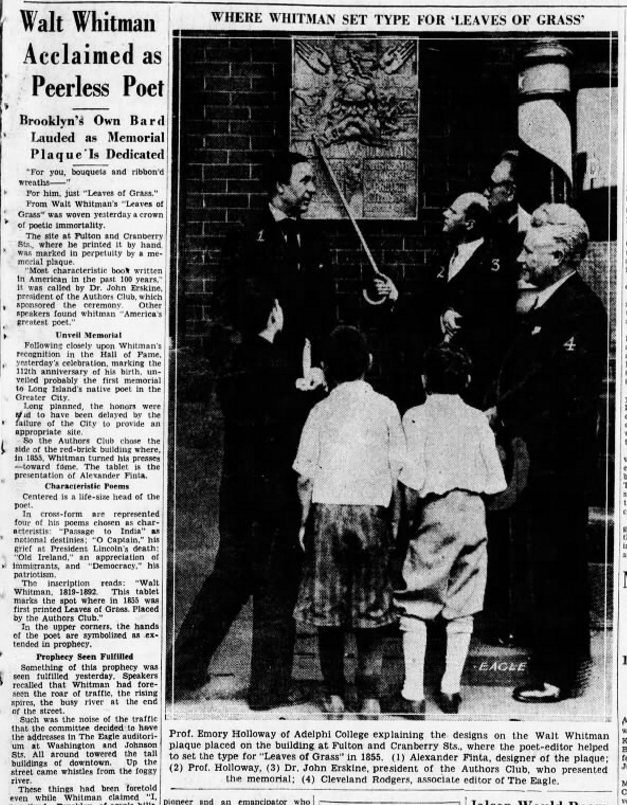
“Walt Whitman Claimed as Peerles Poet.” The Brooklyn Daily Eagle, 01 Jun 1931, pg. 17.