WALT WHITMAN AND BROOKLYN
THE child is already born, and is now living, stout and hearty, who will see Brooklyn numbering one million inhabitants! Its situation for grandeur, beauty and salubrity is unsurpassed probably on the whole surface of the globe; and its destiny is to be among the most famed and choice of the half dozen of the leading cities of the world. And all this, doubtless, before the close of the present century. (Whitman Brooklyniana)
When Walt Whitman arrived with his family in Brooklyn on May 27th, 1823 at the age of four, the bustling village with a population of around 7,000 residents was at the onset of a rapid period of expansion. The development of the waterfront, which included the introduction of Robert Fulton’s steam ferry and the growth of the shipping business, in addition to an increase in stage lines servicing the area, brought a steady stream of travelers and goods through Brooklyn. As businesses expanded, laborers and their families relocated to the area looking for work resulting in a construction boom which Whitman’s father, a carpenter by trade, sought to take advantage of. It was here, in the ferry district on the north side of Fulton street, amongst the immigrant and African American populations, that Whitman spent most of his childhood, moving frequently as building opportunities arose for his father. Juxtaposed next to the palatial estates of Brooklyn Heights, which overlooked the waterfront to the south, this rough and developing neighborhood was a crowded cluster of largely crooked, unpaved streets with few sidewalks, street lights, or public services. Nevertheless, Whitman thrived while receiving a formal education at one of the few public schools in Brooklyn and simultaneously cultivating his “democratic” worldview on the streets during his walks and countless ferry rides back and forth to New York City.
In 1831, when he was 12, Whitman began his apprenticeship in journalism and printing in Brooklyn, learning typesetting from William Hartshorne at the Long Island Patriot and publishing his first pieces in the paper. He continued his training as a compositor for Alden Spooner’s Long Island Star in 1832 and further developed his knowledge of print design and process, skills that he would employ throughout his life in the publication of his own writing. Through his work with Spooner, a popular local figure who advocated for vital infrastructure improvements in Brooklyn through his weekly paper, Whitman also gained early exposure to the power of the printed word in forming public opinion and influencing social change. Whitman would remain at his apprenticeship for three more years, staying even after his family returned to Long Island, before leaving Brooklyn himself in 1835 to pursue employment opportunities in New York City.
Ten years later, in 1845, when Whitman returned to Brooklyn, the small city he left had grown considerably, now covering over twelve square miles with a population of over 36,000 people. He once again lived with his family, who had also recently returned to the area, and began working for the Evening Star briefly before taking over the editorship of the Brooklyn Daily Eagle in 1846. He used his time as editor to pursue a varied agenda, advocating locally for the formation of Ft. Greene public park and other civic improvements, while also covering a range of political issues including the Wilmot Proviso, a hotly contested piece of legislation prohibiting slavery in newly acquired American territories. Whitman’s support of the Wilmot Proviso put him at odds with the Democratic party and the Eagle’s owners, and would lead to his eventual dismissal from the paper 1848.
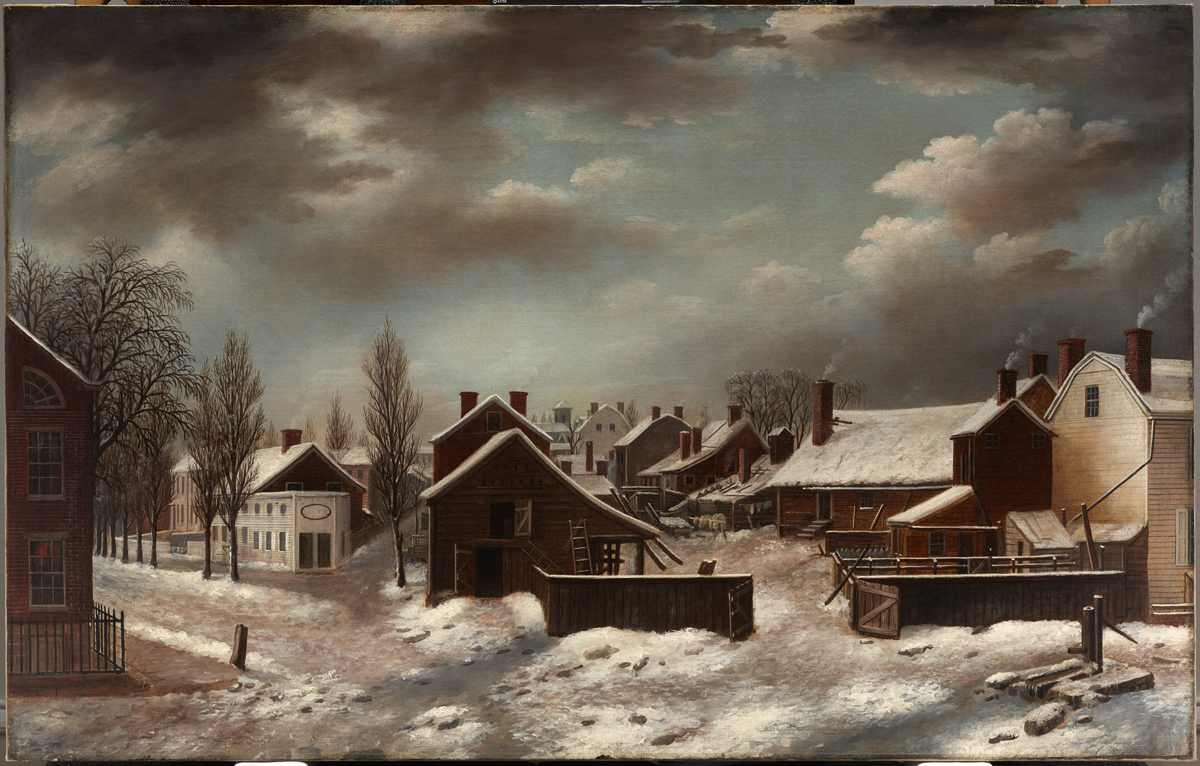
Guy, Francis. Winter Scene in Brooklyn. Dallas Museum of Art. c. 1817–1820
In the years following his journalism and editorial work, Whitman ran a small print shop and bookstore, and also spent time as a carpenter buying and selling properties. It was during this time that he also shifted his focus toward writing poetry and producing the first edition of Leaves of Grass. Published in late June 1855 at Andrew Rome’s print shop, just before his father passed away on July 11th, this book of poems emerged from Whitman’s experiences in Brooklyn and New York and would become his life work.
Following another stint as a newspaper editor, this time for the Brooklyn Daily Times between 1857 and 1859, Whitman would leave Brooklyn in 1862 to locate his brother George in Virginia after the Battle of Fredericksburg. Aside from a six month period in 1864 when he returned to Brooklyn to recover from an illness contracted during the Civil War, Whitman would only return to the city periodically for business and to visit his family. He would never again reside in the city of his youth, the city that informed his world view, shaped his career, and launched his celebrated book of poetry.
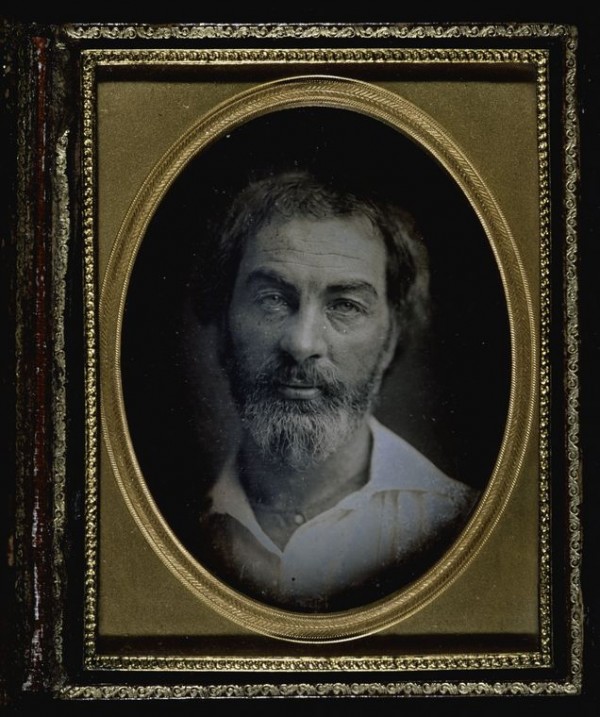
“Daguerreotype portrait of Walt Whitman.” Rare Book Division, The New York Public Library. The New York Public Library Digital Collections. 1853.