WHITMAN AND NEWSPAPERS
In 1831, at the age of 12, Walt Whitman took his first position at a newspaper working for Samuel E. Clement, the editor of the Long Island Patriot. At the small 4-page weekly, located on Fulton Street near Nassau, Whitman received his first lessons in type setting from William Hartshorne, the foreman printer, and also occasionally he would contribute short pieces to the publication. It was the beginning of a career in newspapers and journalism that would span over 25 years and would significantly shape Whitman’s writing process, style, and subject matter.
After leaving Brooklyn with his family in 1835, Whitman continued his newspaper training in Long Island working as a compositor at the Long Island Star until 1835. Shortly after, before he had even turned 20, Whitman launched his own newspaper, the Long Islander, in 1838. Although he sold the paper after only a year, Whitman gained valuable experience editing and managing a press, and on his long rambling runs to deliver the paper, he also began to understand and appreciate the personal and gratifying connection between his work, the places he travelled, and his readers. As he would reflect later in his life,“I never had happier jaunts–going over to south side, to babylon, down the south road, across to Smithtown and Comac, and back home. The experiences of those jaunts, the dear old-fashion’d farmers and their wives, the stops by the hayfields, the hospitality, nice dinners, occasional evenings, the girls, the rides through the brush, come up in my memory to this day ” (Specimen Days 287).
In 1839, Whitman returned to work as a typesetter for the Long Island Democrat in Jamaica, Queens, where he also published several of his early poems and a series of articles titled “Sun-Down Papers from the Desk of a School Master.” As his resume grew, however, Whitman became increasingly restless and he eyed the urban excitement of Manhattan and the growing number of opportunities at the city’s daily papers. Between 1842 and 1845, Whitman lived in New York City and took positions at multiple newspapers including editorships at the Aurora, Evening Tattler, and Democrat. He also published several poems, articles, and his temperance novel Franklin Evans; or the Inebriate: A Tale of the Times for the New World (1842).
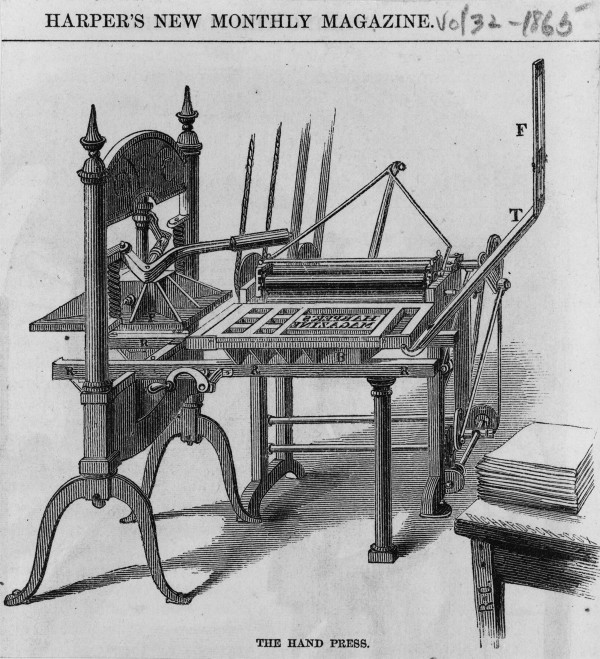
“The Hand press.” Harper’s New Monthly Magazine, vol. 32, 1865, Library of Congress Prints and Photographs Division.
For unknown reasons, Whitman left Manhattan in 1845 and joined his family back in Brooklyn. He quickly found work at the Brooklyn Evening Star before landing a position as editor of the Brooklyn Daily Eagle in 1846. The conservative Democratic newspaper, owned by Isaac Van Anden, was located at 30 Fulton Street near the Fulton Ferry Landing and had a circulation of around 2,000 copies. When Whitman started, the four-page daily was printed on a hand press and was composed almost entirely of advertisements and notices. He was responsible for writing at least two columns of original material each day in addition to curating poems, stories, and news articles from other publications for reprint. In the afternoon, once the copy had been sent to the press, Whitman would leave his office and go on one of his beloved rambles, immersing himself in the city, conversing with Brooklyn residents, and cataloguing in vivid detail the sights and sounds around him. These walks connected him to the local issues and life on the streets, which he then reported back to his audience in the direct and personal style that would become one of the hallmarks of his poetic voice:
“There is a curious kind of sympathy (haven’t you ever thought it before?) that arises in the mind of a newspaper conductor with the public he serves. He gets to love them. Daily communion creates a sort of brotherhood and sisterhood between the two parties, As for us, we like this. We like it better than the more ‘dignified’ part of editorial labors–the grave political disquisition, the contests of faction, and so on” (Brooklyn Daily Eagle 1 June 1846).
In 1848, Whitman’s tenure at the Eagle ended abruptly after his support for the Wilmot Proviso, a proposal which aimed to prohibit slavery in territories acquired after the Mexican American War, went against the Democratic party’s stance on the issue. Whitman would travel to New Orleans to edit the Daily Crescent for a short time later that same year before returning to found the “free-soil” newspaper, the Brooklyn Weekly Freeman. By the end of 1849, Whitman took a long hiatus from the newspaper business as he began to focus on writing and producing Leaves of Grass. He would return to edit the Brooklyn Daily Times between 1857 and 1859, but the balance between his journalism and poetry had shifted to the latter. After leaving the Brooklyn Daily Times for Boston to oversee the third edition printing of his book, Whitman would never fully return to newspaper work again.